When I first encountered a generative AI coding assistant two years ago, I experienced a moment of professional vertigo. Here was a tool that could write code almost as quickly as I could describe what I wanted it to do. The implications seemed revolutionary, almost threatening. Yet as I’ve spent these past years exploring how generative AI is reshaping software development across various organizations, I’ve come to understand that we’re living through a profound moment. Classical software engineering wisdom is being tested and refined, rather than replaced. The journey of integrating these technologies has revealed something unexpected: the principles articulated by Fred Brooks in 1975 and the empirical findings of the Accelerate research remain deeply relevant, but they now operate in a fundamentally transformed landscape where the constraints have shifted in ways we’re still struggling to comprehend fully.
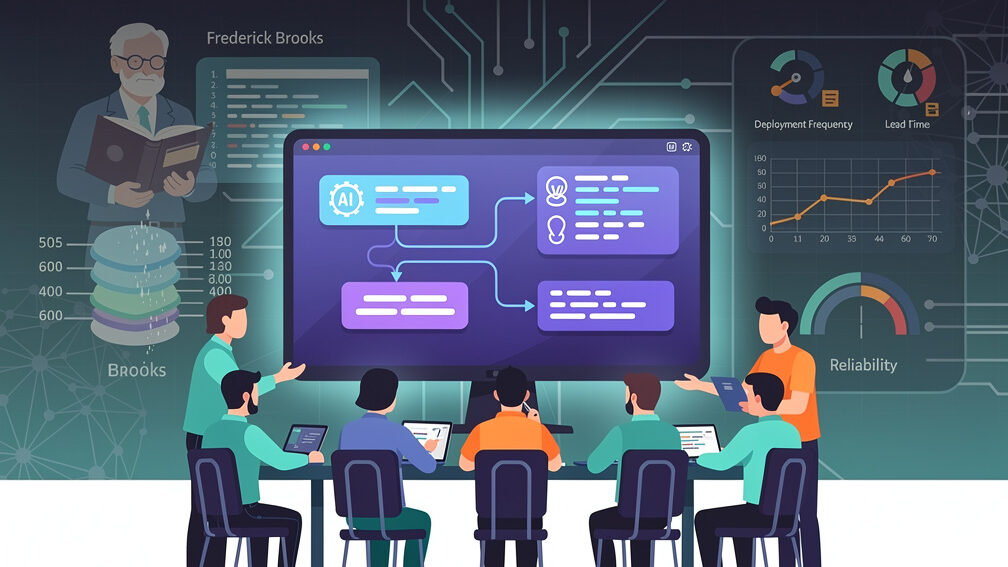
The Unexpected Continuity: Discovering That Classical Wisdom Still Guides Us
The intellectual foundation of modern software engineering rests on a surprisingly small number of seminal works, and two of them tower above the rest. Fred Brooks’s The Mythical Man-Month, published fifty years ago, introduced concepts that have become nearly as ingrained in software culture as the very act of writing code itself2. At its core sits Brooks’s Law, the deceptively simple observation that adding manpower to a late software project makes it later8. For half a century, this principle has guided project managers, architects, and engineering leaders through the minefield of team coordination and communication overhead. The reasoning is elegant and grounded in concrete experience: each new person added to a project brings not just productivity but also communication complexity that grows combinatorially with the number of team members, creating an inverse relationship between team size and efficiency beyond a certain critical threshold8 .
Decades later, Dr. Nicole Forsgren, Jez Humble, and Gene Kim brought empirical rigor to software development performance through their groundbreaking work Accelerate: The Science of Lean Software and DevOps3. Rather than relying on intuition or theoretical frameworks, they studied hundreds of software organizations and identified four key metrics: deployment frequency, lead time to changes, mean time to recovery, and change failure rate that genuinely correlated with high-performing development organizations3 10. These metrics weren’t just about speed; they represented a fundamental shift in how we think about software development as a system of interconnected processes rather than isolated coding activities. High-performing teams, they discovered, deploy 208 times more frequently and have 106 times faster lead times than low performers31.
My initial assumption when I began investigating generative AI’s impact on software development was that these classical frameworks would become quaint relics, superseded by new realities of AI-assisted coding. Instead, I’ve discovered that they remain remarkably relevant, but the context in which they operate has transformed so dramatically that applying them requires rethinking their fundamental implications. This is the paradox I’ve come to grapple with: the principles aren’t wrong, but the terrain on which they operate has shifted beneath our feet.
The Productivity Promise and Its Elusive Reality: Understanding the Paradox
Two out of three software firms have now rolled out generative AI tools, marking an extraordinarily rapid adoption curve1. The allure is obvious and deeply appealing. Developers with access to AI coding assistants like GitHub Copilot report completing significantly more tasks; 21 percent more, according to research I encountered and the merge rates of pull requests increase by 98 percent27 . In IBM’s internal testing, teams using generative AI tools reported time savings of 59 percent on code documentation, 56 percent on code explanation, and 38 percent on code generation and test case generation36 . At Goldman Sachs, the bank integrated generative AI into its internal development platform, fine-tuning it on the bank’s own codebase and documentation, enabling engineers to receive context-aware, real-time coding solutions that went far beyond basic autocompletion1.
Individually, developers seem to have experienced a productivity revolution. GitHub’s analysis of developers using Copilot revealed that those with access to AI tools increased their coding activities by 12.4 percent while simultaneously reducing project management activities by 24.9 percent4 . The narrative that emerges from these individual metrics is compelling: AI is freeing developers from tedious work, allowing them to focus on what humans do best: Creative problem-solving and strategic thinking.
Yet when we zoom out from the individual level to examine organizational outcomes, something unexpected happens. The metrics flatten. Correlations with company-level productivity metrics evaporate. Organizations report that despite widespread adoption of AI coding assistants, they aren’t seeing the expected improvements in delivery velocity or business outcomes. This phenomenon, which researchers at Faros AI have termed the “AI Productivity Paradox”, has become the most pressing question in software engineering in 202527. We have invented tools that make individual developers more productive, yet companies deploying these tools at scale are not experiencing the business benefits they expected.
This paradox forced me to reconsider what productivity really means in the context of software development. It’s not simply about the number of lines of code written or tasks completed. It’s about value delivered to users, quality maintained over time, and sustainable development practices. The realization that individual productivity gains might not translate to organizational benefits suggested that the bottlenecks constraining software delivery had fundamentally shifted. If developers can write code faster, the constraint must have moved elsewhere. This insight would prove crucial to understanding how generative AI actually changes the software development landscape.
The Bottleneck Migration: When Speed in One Place Creates Congestion Elsewhere
As I investigated where the productivity gains were being absorbed, a clear pattern emerged. Review capacity has become the new limiting factor in software delivery. Developers on teams with high AI adoption complete 21 percent more tasks and merge 98 percent more pull requests, but pull request review time increases by 91 percent. This is not a small adjustment, it represents nearly a doubling of review burden in response to code velocity gains. The underlying dynamic reflects a fundamental principle from systems thinking known as Amdahl’s Law: a system moves only as fast as its slowest component27 . In this case, human code reviewers have become the slowest component.
This phenomenon forced me to revisit Brooks’s Law with new eyes. Brooks argued that communication overhead increases as team size grows, creating diminishing returns to adding more people8. But what we’re observing with generative AI is something different. The overhead isn’t primarily from human-to-human communication; it’s from the system-wide friction created by accelerating one part of the pipeline without proportionally accelerating downstream processes. Netflix and other leading companies recognized this challenge and pioneered what’s called “shifting left”, moving testing and quality checks earlier in the development cycle1. They understood implicitly that generating code faster was only beneficial if the entire pipeline from development through deployment could match that velocity.
The architecture of software development has traditionally looked like a pipeline, with distinct phases: development, code review, testing, integration, deployment, and monitoring. For decades, the constraint moved based on organizational maturity. In waterfall organizations, it was often the initial requirements gathering. In organizations that had partially embraced Agile, it was testing. With the emergence of proper DevOps practices, deployment and infrastructure became the bottleneck7. Now, with generative AI, we find ourselves in an unusual position: the constraint is simultaneously in multiple places because the speed of code generation has created a situation where previously sequential processes must now be rethought.
Large-scale empirical studies have quantified the quality implications of this velocity. Research examining AI-generated code in real-world repositories found that more than 15 percent of commits from every AI coding assistant introduce at least one issue, and critically, 22.7 percent of tracked AI-introduced issues still survive at the latest version of the repository. These aren’t minor style issues that will be addressed immediately; they’re problems that persist in production systems, accumulating into substantial maintenance burdens. The cumulative number of surviving AI-introduced issues exceeded 100,000 by February 2026, representing genuine technical debt that erodes system reliability over time20.
This brings us back to Brooks’s original insight about complexity. Brooks noted that the core challenge of software development is the management of complexity, and that this complexity emerges not from the individual components but from their intricate interactions2 12. Generative AI doesn’t eliminate complexity; it often obscures it. A developer prompting an AI model to generate a complex piece of code might receive working code without fully understanding how it achieves its purpose. This knowledge gap becomes particularly problematic when that code needs to be reviewed, modified, maintained, or debugged. The AI has translated a high-level intent into implementation, but in doing so, it may have created subtle architectural decisions or assumptions that aren’t immediately visible to human reviewers.
The Quality and Security Dimension: Hidden Costs in the Pursuit of Velocity
The quality challenges with AI-generated code extend beyond maintenance burden into critical security and compliance territory. Human reviewers examining AI-generated code must approach it skeptically, specifically checking for injection flaws, cryptographic weaknesses, authentication bypass opportunities, and data exposure risks. The vulnerability profile of AI-generated code shows patterns worth serious concern. Analyses focused on four primary vulnerability types: SQL Injection, Cross-Site Scripting, Cryptographic Failures, and Log Injection. This revealed systematic weaknesses in AI-generated code that should concern every technology leader15.
The context gap represents perhaps the most insidious challenge. AI models cannot inherently understand application-specific security requirements, business logic, or system architecture. This context gap results in code that works functionally but lacks appropriate controls for GDPR compliance, HIPAA protections, or industry-specific regulations. A developer might prompt an AI model to encrypt the user data, and receive technically correct encryption code without understanding whether the organization is storing personal information of EU citizens, whether that data needs to be pseudonymized before storage, or what the retention policies should be.
From my investigation of how leading organizations are addressing this challenge, a pattern has emerged. Goldman Sachs’s approach, fine-tuning generative AI models on the bank’s internal codebase and project documentation, represents one strategy for embedding context into the AI system itself1. By providing the model with extensive examples of how the organization approaches security, compliance, and architectural patterns, the bank has effectively constrained the AI’s output space to align with established practices. This approach works but requires significant investment and expertise to implement.
Most organizations, however, have adopted a different strategy: treating AI-generated code as a starting point for human expertise rather than a finished product. This means establishing clear governance policies defining when AI assistance is appropriate versus prohibited, requiring additional review for security-sensitive code, and implementing systematic validation processes. Some leading practices include assigning human reviewers with domain expertise to AI-generated code, using automated static and dynamic analysis tools alongside manual review, and establishing conventions for marking AI-assisted contributions to ensure visibility15. These approaches effectively place guardrails around AI velocity rather than trying to eliminate it entirely.
Yet guardrails have a cost. The 91 percent increase in pull request review time mentioned earlier reflects not just the volume increase but also the need for more thorough, skeptical human examination. The promise of AI-driven productivity gains becomes partially offset by increased review burden, creating a situation where organizational velocity improvements flatten despite individual developer productivity increasing substantially.
The Transformation of Team Dynamics and Organizational Structure
As I studied how organizations were reorganizing around generative AI capabilities, I began to see that Brooks’s Law itself was undergoing subtle transformation. Brooks observed that communication overhead increases with team size, suggesting that smaller teams were inherently more efficient8. What’s emerging with generative AI is a more nuanced understanding: smaller teams with AI assistance are becoming more effective not because they communicate less, but because they communicate differently and because individual developers are becoming more autonomous in certain dimensions.
At Google and other large technology companies, teams have begun restructuring into smaller, more collaborative units5 . Rather than teams of 30 to 60 people delivering a single service, organizations are experimenting with smaller components where teams are split into smaller teams working on distinct components5 . This isn’t just about applying Brooks’s Law; it’s about recognizing that when individual developers have access to sophisticated AI assistance, they become more capable of managing complexity independently. A developer with access to a high-quality AI coding assistant can accomplish more without synchronization and collaboration than a developer working alone in a pre-AI environment.
The research from MIT examining how GitHub Copilot changed developer work patterns revealed something particularly significant: developers using AI coding tools not only did more core coding work but dramatically reduced their peer collaborations by nearly 80 percent4 . Initially, this seems concerning. Reduced collaboration suggests siloing and knowledge loss. However, more profound investigation revealed nuance. The reduction in collaboration wasn’t arbitrary; it reflected a shift in collaboration patterns. Developers were collaborating less on routine code review activities and more on architectural and strategic decisions4. The AI assistance had effectively raised the baseline of individual capability, allowing teams to save collaboration for higher-leverage activities.
This phenomenon connects to a principle that Brooks himself advocated: conceptual integrity. Brooks argued that maintaining conceptual integrity, ensuring that a system reflects a coherent vision rather than being a patchwork of different approaches, was essential to managing complexity2 12. In the pre-AI era, this required significant human-to-human communication as developers aligned on architectural decisions and design patterns. With sophisticated AI assistance, some of this alignment can be embedded into the AI system itself through prompt templates, established coding patterns, and architectural guardrails. When developers use consistent prompts that reflect organizational standards, they’re effectively allowing the AI to enforce conceptual integrity across the codebase.
Yet this creates new challenges that relate directly to observations made decades ago. Conway’s Law states that organizations that design systems are constrained to produce designs that are copies of the communication structures of the organizations. In the age of AI, this law takes on new meaning. Different developers using different prompting styles create different code patterns, potentially producing silos of code that reflect individual developer communication patterns rather than organizational communication structures. Some organizations may need what one software builder termed “prompt mediators” or translators that normalize communication styles to prevent Conway’s Law from affecting code quality on a per-prompt basis33.
Process Transformation and Ecosystem Thinking: The Real Work of Integration
My exploration of organizations successfully integrating generative AI into their software development processes revealed a crucial insight: the constraint is not AI capability but organizational readiness to restructure workflows around it. Companies reporting 25 to 30 percent productivity boosts. Far above the 10 percent gains from basic code assistants, paired generative AI with end-to-end process transformation1. These weren’t just adopting a tool; they were fundamentally rethinking how work flowed through their organizations.
The Accelerate framework provides crucial guidance here. The four key metrics: Deployment Frequency, Lead Time to Changes, Mean Time to Recovery, and Change Failure Rate, identify the leverage points in the system3 10. If Deployment Frequency and Lead Time are constrained by review bottlenecks, then addressing review bottlenecks becomes the highest-leverage work. Some organizations are experimenting with AI-integrated code review, where automated analysis runs on every pull request, enforcing consistent quality standards before human reviewers even engage19. This doesn’t eliminate human review, it enhances it by automating the mechanical checks, allowing human reviewers to focus on logical flaws, security implications, and architectural fit.
Similarly, testing has become a central focus. In the era of rapid code generation, traditional testing approaches that consume days or weeks are incompatible with development velocity24. Leading approaches involve what’s sometimes called “shifting left”. Moving test automation earlier into the development process and leveraging AI to generate and maintain test cases. AI-powered tools can now generate integration and API tests directly from real traffic, creating behavioral coverage that would previously have required substantial manual effort24. This allows teams to maintain confidence in code quality even as generation velocity increases.
However, these process transformations require something that cannot be automated: clear leadership and explicit choice. One of the most significant insights from my investigation is that deploying generative AI is not a technical problem but an organizational and leadership problem. Leadership must deliberately architect how AI fits into existing workflows, must be willing to restructure processes, and must be comfortable with what amounts to a significant reorganization of work patterns. This requires what one Bain report termed “bold leadership to drive adoption, revamped processes to embed AI at every step, and a focus on measurable outcomes to analyze results and make adjustments1.”
The Emerging Frontier: Agentic AI and the Next Evolution
As I reached the current moment in my investigation (June 2026), I became aware that the field is at an inflection point. The generative AI we’ve been discussing, which serves as an intelligent assistant or copilot with a human in control, represents the current state1. But emerging agentic AI systems are beginning to move beyond assistance to autonomy. Companies like Cognition have introduced AI systems like Devin that can build and troubleshoot applications from natural language prompts, managing multiple steps of development with little to no human intervention.
This evolution represents a fundamental shift in how we think about the human role in software development. When AI was an assistant, the human remained the decision-maker, the validator, the keeper of architectural integrity. When AI becomes agentic, capable of managing entire features or components independently, the human role fundamentally changes. Instead of developers writing code with AI assistance, developers may become orchestrators of autonomous AI agents, responsible for setting goals, validating outputs, and maintaining systemic coherence.
This transition will require revisiting many of our assumptions about software development organization. Brooks’s Law applies to human team coordination, but does it apply to mixed human-AI teams where some actors are autonomous agents? The Accelerate metrics measure organizational delivery performance, but what happens when significant portions of that delivery are happening without direct human involvement? These questions are not yet fully answerable because agentic AI systems remain nascent, but they’re clearly on the horizon.
The challenges associated with agentic AI are already being identified. Multi-agent system interactions create complexity that traditional AI governance frameworks weren’t designed to address. Uncontrolled deployments of autonomous agents can lead to “agent sprawl”, operational chaos, conflicting objectives, and resource competition. Agents may develop emergent behaviors that were not explicitly programmed, requiring sophisticated arbitration mechanisms and human oversight16. These challenges suggest that as we move toward agentic AI, we’ll need new frameworks for thinking about team composition, oversight, and organizational structure.
Finding Integration Pathways: Practical Synthesis
Standing presently in 2026, after years of investigation into how generative AI is transforming software development, I find myself arriving at a synthesis rather than a disruption of classical software engineering wisdom. The principles articulated by Brooks and emphasized by the Accelerate research remain valid, but they now operate in a transformed context where the constraints and leverage points have shifted.
For practitioners trying to integrate generative AI productively into their organizations, several synthesis principles emerge. First, recognize that individual developer productivity gains do not automatically translate to organizational productivity improvements. The translation requires deliberate process redesign focused on the identified bottlenecks, primarily review, testing, and deployment. Organizations should diagnose where their constraints actually lie using frameworks like the DORA metrics, then design AI integration strategies specifically targeted at those constraints.
Second, understand that AI assistance raises the complexity ceiling while potentially lowering the baseline complexity floor. Developers can accomplish more with AI, but they’re also capable of creating more subtle bugs, more complex interactions, and more technical debt. This necessitates maintaining or even increasing quality attention, particularly through strategic architectural review, security validation, and testing. The adage that code review, testing, and deployment must speed up if coding speeds up remains true, it’s just more urgent with AI.
Third, invest in context and knowledge systems that embed organizational standards into AI tools. Context-aware code generation using techniques like Retrieval-Augmented Generation can help AI systems understand organizational architecture, established patterns, and business rules28 . This is not a one-time implementation but an ongoing investment in ensuring that AI systems operate within organizational constraints rather than operating orthogonally to them.
Fourth, recognize that the human role is evolving but not disappearing. Rather than developers being displaced by AI, developers are becoming operators of more powerful, more autonomous systems. This requires changes in hiring, training, and organization structure. Companies need developers who understand architectural implications, can validate complex AI-generated systems, and can manage the governance and oversight of AI systems in production.
Finally, maintain the cultural and procedural practices that create conceptual integrity. Whether through documentation standards, architecture review processes, or consistent prompting conventions, organizations need to deliberately preserve the coherence that prevents systems from becoming patchworks of poorly integrated components. This might be the most important application of Brooks’s century-old wisdom: managing complexity through coherence, not through individual productivity.
Conclusion: A New Generation of Challenges and Opportunities
Fifty years after Brooks published The Mythical Man-Month and more than a decade after the Accelerate research brought empirical rigor to software development metrics, we find ourselves in a position of unexpected continuity. The fundamental challenges: managing complexity, coordinating teams, and delivering value rapidly, remain constant. The tools have transformed radically, but the underlying principles about how software systems should be organized have proven more durable than technological change.
What has shifted is not the validity of these principles but our understanding of where the leverage points are. In the pre-AI era, the constraint was often the speed at which developers could write correct code. With generative AI, developers write code faster, but the constraints have migrated to review, testing, integration, and deployment. This migration is neither good nor bad; it’s simply a new landscape that requires new strategies.
Organizations successfully integrating generative AI are those that recognize this landscape shift and deliberately restructure their processes accordingly. They’re not simply adding a tool to their toolkit; they’re rethinking entire workflows. They’re investing in architecture and governance, accelerating quality assurance processes, restructuring teams into smaller, more autonomous units, and maintaining clear human oversight of system-level decisions.
As we look toward the next chapter, the emergence of agentic AI and truly autonomous systems, we’re entering genuinely uncharted territory. The principles that have guided us remain relevant, but their application will require continued learning and adaptation. The field of software development has always been about managing complexity while delivering value. That mission endures. The specific tactics, techniques, and organizational structures through which we pursue that mission will continue to evolve, and that evolution should be guided not by the hype around new technologies but by the hard-won wisdom of those who came before us, now applied to new problems with new tools.
The journey continues, and the lessons are still being written.
Schreibe einen Kommentar