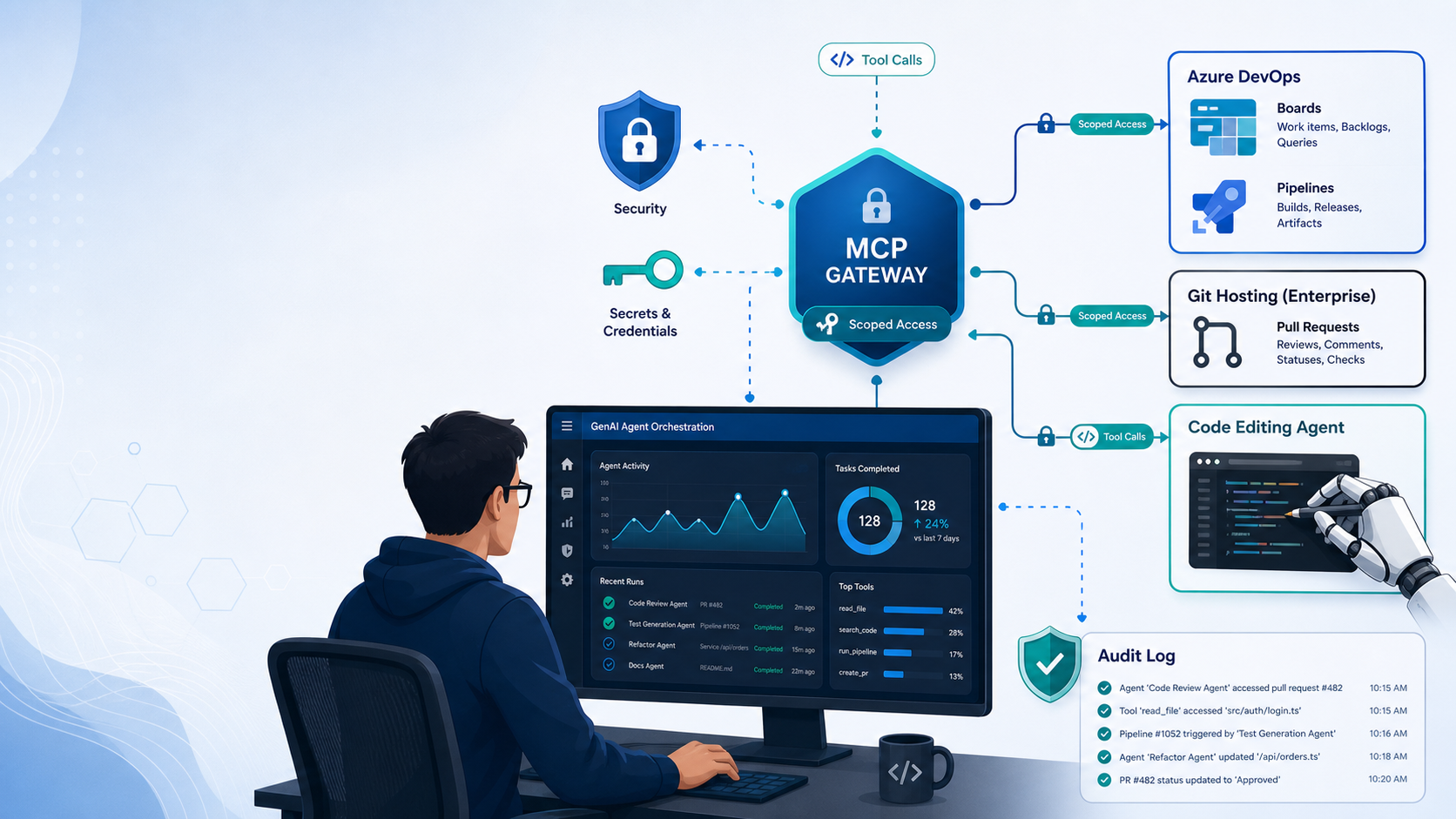
The ideas around agents become much more real when they stop being abstract diagrams and start wiring into the tools I use every day.
I work in an enterprise environment, trying to introduce GenAI into an already complex software development lifecycle. That means I care less about toy demos and more about: How does this plug into Azure DevOps? Who gets access to what? What happens when it’s wrong? How to get people on board seeing the benefit of working with these systems?
That is where MCP servers, PR review agents, and tools like OpenClaw have started to matter a lot in my day‑to‑day thinking.
Model Context Protocol: giving agents real, scoped powers
The Model Context Protocol (MCP) is basically a standard way to give AI tools access to real systems, repos, work items, pipelines, through a secure, tool‑like interface.3 Instead of pasting API tokens into Vibe-coded tools or local HTML websites, you set up an MCP server that knows how to talk to, say, Azure DevOps, and your agent talks to that MCP server.
For Azure DevOps, Microsoft, and the community now provide an Azure DevOps MCP Server that exposes projects, repos, work items, pipelines, and more.2 5 In practice, that means I can ask an AI assistant questions like:
“What’s the status of the login bug in Project X?”
and the MCP server translates that into a real Azure DevOps query, filters for the relevant bug, and returns current status and metadata.3
The official docs describe this as a two‑step process: the MCP server retrieves data from Azure DevOps and the AI then analyzes it, so the model is always working against live project context instead of hallucinating generic answers.2 For me as an enterprise engineer, that separation matters: the MCP server enforces access, scopes queries, and can even run locally so project data does not leave our network.3
Bug creation and triage as a first‑class “skill”
Once you have that MCP plumbing, you can start doing more interesting things than just “show me a list of bugs.”
One pattern I really like is turning bug creation + triage into a skill that an agent can execute with some autonomy. For example, with an Azure DevOps MCP server wired in, you can say something like:
“Create a bug work item for the authentication issue and link it to the current feature branch.”
and the MCP server handles all the Azure DevOps API calls, creating the work item, linking it to the branch, and so on.5
From there, you can layer on a skill that performs triage while creating the bug:
- analyze logs or telemetry to infer component/area (for example using an
azure-app-insightsskill to gather signals first)1 - map that to your team ownership model (service name → team)
- set the right area path, tags, and severity
- check for existing related work items and link or update when appropriate, instead of filing duplicates1 5 7
Microsoft’s own examples for the Azure DevOps MCP server explicitly call out fetching all backlog items and triaging them according to custom criteria, including identifying security‑relevant work, grouping similar bugs, and prioritizing based on impact.7 That is exactly the kind of thing we end up doing manually today in spreadsheets and long triage meetings.
In my head, this is where the “agent” aspect really shows up:
- the MCP server is the secure gateway to real project data
- the triage skill encodes our process: how we interpret telemetry, how we map issues to teams, how we word titles and descriptions
- the agent executes that skill repeatedly, consistently, and audibly
And because I work in an enterprise setting, the appeal is not just speed; it is consistent application of our own rules. If we decide “auth bugs always go to Team A unless they’re in Service B,” that logic lives in the skill instead of in people’s memories.
Of course, this also raises the stakes for data access and security. MCP servers for Azure DevOps are explicitly pitched as a way to do this safely: they run close to your data, enforce granular access policies, and defend against AI‑specific threats like prompt injection or tool poisoning.3 This becomes especially difficult to roll out to non-developer or non-technical people. Currently, good and useful agentic systems are rare, expensive, or coupled to a system with a different use case (like GitHub CoPilot).
GitHub Enterprise PR review agents: helpful, but not your only reviewer
On the GitHub side, the story is similar but somewhat included in the website structure. Let’s have a look around pull requests.
GitHub already offers AI assistance for code (GitHub CoPilot), but we are starting to see more specialized PR review agents in GitHub Enterprise setups: agents that can:
- read the diff and relevant surrounding context
- summarize what changed in business‑level language
- flag potential anti‑patterns or security smells
- suggest additional tests
- cross‑check the PR against existing issues or work items
Conceptually, a PR review agent is just another role‑specific agent: a “reviewer” that has read the code and brings a very consistent, tireless checklist to every change. The value is obvious in an enterprise context where review bandwidth is scarce.
But there are real questions here. A model that reads the patch and litters the PR with noisy, low‑value comments is not helping; it is creating alert fatigue in code review form. There is also the risk that humans start skimming because “the bot would have caught anything serious.” The same automation bias we know from other domains can appear in reviews.
I see these agents as most useful when:
- they are tuned to project‑specific standards, not just generic style rules
- their comments are few and high‑signal
- teams keep a norm that human approval is non‑negotiable, and the agent is a helper, not the final authority
In other words: I want the PR agent as an extra set of eyes, not as an excuse to stop looking.
And this is why a built in solution like the one in GHE, is a bit more sophisticated than what we tried to copy in our Azure DevOps space, by creating our own PR Review agent.
OpenClaw‑style code agents: when the agent edits the repo
Then there are tools like OpenClaw and similar code‑editing agents that go beyond “here is a suggested patch” and into “I will open a branch, edit multiple files, run tests, and send you a pull request.”
These agents typically:
- index the repository to build a semantic map of the code
- accept a high‑level instruction (“migrate this module to use library X,” “extract this pattern into a reusable component”)
- plan the work as a series of edits
- apply those edits across files
- run tests or linters and adjust if something breaks
- hand you a PR or commit for review
In spirit, they are very close to the Azure DevOps + MCP scenario, just operating directly on the repo instead of through work items.
When I imagine wiring something like OpenClaw into enterprise repos, my feelings are mixed in a productive way:
- The optimist in me sees a way to encode large‑scale refactors as skills and then let an agent do the tedious mechanical work under supervision.
- The cautious engineer in me worries about subtle behavior changes, test gaps, and the human habit of trusting agents that “usually work.”
This is where the socio‑technical questions come back:
- Who owns the outcome of an agent‑generated PR?
- How do we ensure the review is more than a rubber stamp on a long, model‑written diff?
- How do we trace back “why” certain decisions were made if most of the micro‑design happened inside an agent loop?
While I hoped to update and maintain some older projects with OpenClaw, the success rate was rather disappointing. Let’s say at the time I tried it; it was too expensive to be valuable enough to run it longer than as an experiment. On the other hand, I value the result of things like dependabot, which I kept using in one or the other version. 10
Positively biased, scientifically suspicious
Day‑to‑day, I try to keep a stance that is positively biased towards GenAI but scientifically suspicious.
Positively biased, because:
- I have seen agents plus MCP servers genuinely reduce toil: triaging telemetry and creating well‑formed Azure DevOps tasks with links and evidence, instead of forcing humans to copy‑paste Kusto queries and stack traces into tickets.1 5 7
- I can imagine PR review agents catching whole classes of issues that we all mean to watch for but often miss in a rush.
- Code‑editing agents, used carefully, can make scary refactors feel tractable.
- Trivial maintenance tasks to be done automatically
Scientifically suspicious, because:
- We know LLMs can hallucinate and sometimes produce confident but wrong analyses. (Specifically on outdated wikis and work items.)
- We know automation can create new failure modes (over‑trust, blind spots, skill erosion), not just remove old ones.
- We know integrating MCP servers and agents changes the information flow and responsibility in our teams, and those changes need to be surfaced, not swept under the rug.
- We know that costs matter, and the right task needs to be addressed with the right tool (or person).11
Working in an enterprise company forces me to keep both of these perspectives in frame. I cannot just say, “This is cool!” and push it into production. I have to answer questions about access control, data residency, auditability, incident response, and what we do when the agent’s suggestion conflicts with an engineer’s intuition.
Still, I find it exciting that we are at a point where these questions are practical, not hypothetical. MCP servers for Azure DevOps, GitHub Enterprise review agents, and OpenClaw‑style tools are all concrete technologies that let us explore what GenAI‑augmented software development actually feels like in real organizations.2 3 5 7
For now, my approach is to start small, build very explicit skills like “triage and create a bug for this incident, choosing the right team.” Wrap them in MCP‑backed agents with tight permissions, and then watch both the technical results and the human reactions very closely.
If nothing else, it has made my job more interesting: I am no longer just designing systems for humans and code; I am designing systems where agents sit in the middle, translating between the two.
Schreibe einen Kommentar